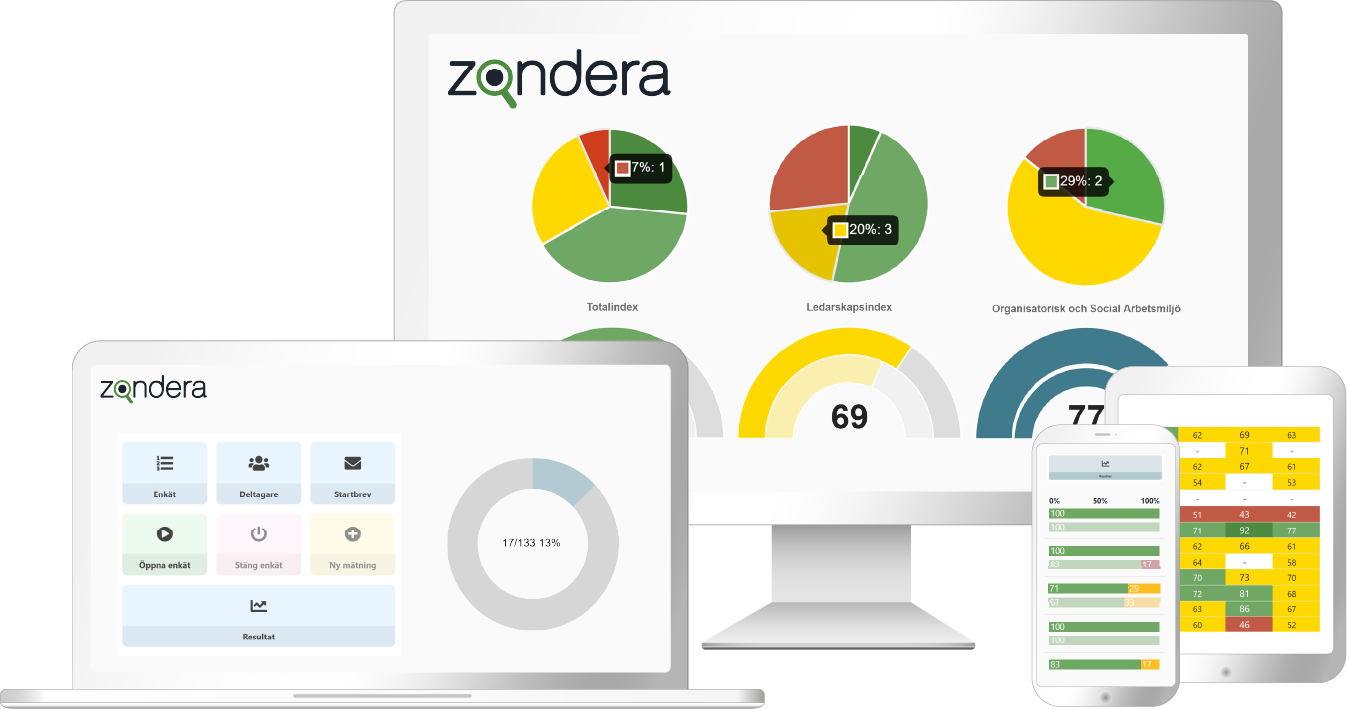
Employee surveys with Zondera

In an employee survey, your employees are given the opportunity to provide information about how they feel and what they think about the work environment. Every employee survey is unique but the goal is always to make your employees feel commitment and satisfaction.

Brief Overview of Our Employee Surveys

Preparation: Our consultants help and support you in the preparation process.

Implementation: Your employees participates in the survey by answering our responsive and easy to use questionaire. Either by computer, phone or tablet.

Result: The result material from the employee survey is accessible and easy to use.

Change: When the survey is done, the most important phase begins - change. Zondera has many years of experience in supporting our customers.

Science

Based on science

Zondera’s employee surveys consist of relevant questions and are based on a scientific ground and well-tried methods. We help you measure your key questions and create bases for decision and follow-up for higher efficiency and profitability. We collaborate with you through the whole process and ensure that you can change and develop the organization based on the result.

Advantages with Zondera´s employee surveys

Responsive questionaires: Our questionaires are responsive.

Consultant support:and presented by our experienced consultants.

Accessible result reports: The result reports are accessible and easy to work with.

A good base: HR gets a good summary and opportunity to do deeper analysis.

Portal with results: In our web portal, all managers have access to their own results and are able to do follow-up measurements on their team, so called PULSE measurements.

Work with the result of your employee survey

Evaluate and Analyze the Results

After conducting an employee survey, it’s crucial not just to present the results but to actively work with them. Start by:

Communicating the results openly – Share both strengths and areas for improvement with managers and employees to foster engagement.
Collaborating on the analysis – HR and managers should work together to identify patterns and root causes in the data.
Following up with additional input – Pulse surveys or follow-up conversations can help employees provide more context and insights.

This collaborative analysis creates a strong foundation for improvement efforts that are aligned with the reality of the organization.

Use Action Plans to Drive Change

Once the analysis is complete, the next step is to turn insights into concrete actions. Each department or team should create an action plan that includes:

Clear goals – What do we want to improve?
Defined responsibilities – Who is doing what?
Timelines – When should it be completed?
Follow-up procedures – How and when will progress be reviewed?

These plans should be practical, grounded in daily operations, and easy to follow up on. HR plays a key role in supporting managers and ensuring that the work continues over time. With clear action plans, the improvement work becomes concrete, achievable, and measurable.

Combine with PULSE measurements

Zondera’s PULSE measurements are a quick and resource efficient way to check the present situation of the organization.

Take the PULSE, either with the aim to follow the trend in your key indexes, to set the focus on a specific area or to follow up the effects of the change activities that have been carried out, for example after the last employee survey.

Everything can be found in our easily used and interactive portal.

Read more about our PULSE measurements

Zondera´s vision

Our vision is that everyone should have the right conditions for a healthy work environment. This often begins with an employee survey and continues with targeted efforts to develop individual managers and employees, groups or whole organizations.

Combined surveys

An employee survey can benefit an extra effect if it can be combined with other aspects of the development of the organisation. Zondera combines your employee surveys with a customer survey or leadership evaluation.

Customer and employee survey

Zondera has developed a method in which questions and results of surveys of customers and employees can be correlated and compared.

The result will help you train the employees in a customer oriented working method and create an attitude in which everyone takes responsibility for the customer experience.

Our research

Zondera works based on an overarching method for conducting surveys developed by Jan Trost, professor emeritus of sociology at Uppsala University. The theoretical background is based on the approach that surveys and studies, quantitative as well as qualitative, put those who are expected to answer the survey in the center and that one seeks to take her or his perspective throughout the entire process of working with the survey.

We also base our methodology on Lekvall and Wahlbin's model to ensure that conclusions and recommendations meet the purpose with the survey. It is also important to ensure that the survey questions can be analyzed in view of the purpose and that the target group and selection are well balanced.

Ethics and guidelines

Vi har ett etiskt förhållningssätt och följer riktlinjerna från branschorganisationen ESOMAR.

The most common purpose in our surveys is to strive for a well-functioning organization, which includes a good working environment and efficiency. In order to achieve this, we have been working for ten years with questions based on research by Dr. Laurie J. Bassi.

Product sheets

Download our product sheets for a summary of our surveys, products and services.

(Only available in Swedish at the moment)

Banner med logotyper av kunder som vi arbetar med - Best Western Hotels & Resorts, Betsson, Estrella, Folkuniversitetet, Hemtex, Nacka kommun, Stockholms Studentbostäder.

FAQ

Here we have gathered answers to common questions about employee surveys.

How often should an employee survey be conducted?

Most organizations conduct a comprehensive employee survey once a year and complement it with regular pulse surveys to monitor progress and changes between survey periods.

What is considered a good response rate for an employee survey?

A response rate above 70% is generally considered reliable and provides a solid foundation for analysis. However, the goal should always be to achieve the highest possible participation rate to ensure representative results.

How long does it take to complete an employee survey?

The time required depends on the scope of the survey, but most employee surveys take between 10 and 20 minutes to complete.

Can the survey questions be customized?

Yes, the survey can be tailored with custom questions and focus areas based on your organization's goals, challenges, and specific needs.

What topics should be included in an employee survey?

Common topics include leadership, work environment, collaboration, communication, workload, motivation, and employee engagement.

How is anonymity ensured in an employee survey?

Responses are aggregated and reported at the group level only. Results are typically displayed only when a sufficient number of responses have been collected, helping to protect the privacy of individual employees.

What is the difference between an employee survey and a pulse survey?

An employee survey provides a broad and in-depth view of the organization, while a pulse survey is shorter and designed for ongoing monitoring and follow-up.

How quickly are the results available?

Results can usually be presented shortly after the survey has closed, allowing organizations to begin analysis and improvement initiatives without delay.

Can survey results be compared over time?

Yes. By tracking the same key areas over time, organizations can identify trends and evaluate the impact of actions and improvement efforts.

Why do some employee surveys fail?

The most common reason is a lack of follow-up action. Employee surveys create the greatest value when they lead to meaningful dialogue, action plans, and continuous improvement efforts.

Contact us

Fill in your contact info to get in touch with us